

Why Compensating for Shaft Misalignment Is Important
In practice, different types of misalignment can occur during power transmission between two shafts.
These can have various causes:
- Bearing clearance
- Thermal expansion
- Manufacturing tolerances
- Assembly deviations
- Design related deviations
This misalignment can affect the function of a machine. If occurring forces are not compensated, higher bearing loads can occur for example.
For this reason, flexible shaft couplings are used. They provide a flexible connection between the drive and the driven side while also transmitting the required torque.
Depending on the application, couplings must meet different requirements:
Requirement | Importance |
Compensation capability | Compensation of radial, axial and angular misalignment |
Torsional stiffness | Accurate transmission of movements |
Vibration damping | Reduction of shocks and vibrations |
Electrical isolation | Prevention of electrical connection |
Thermal isolation | Protection against heat transfer |
Durability | Use under different environmental conditions |
No type of coupling combines all properties completely. Therefore, the selection must always be adapted to the specific application.
What is a double loop coupling?
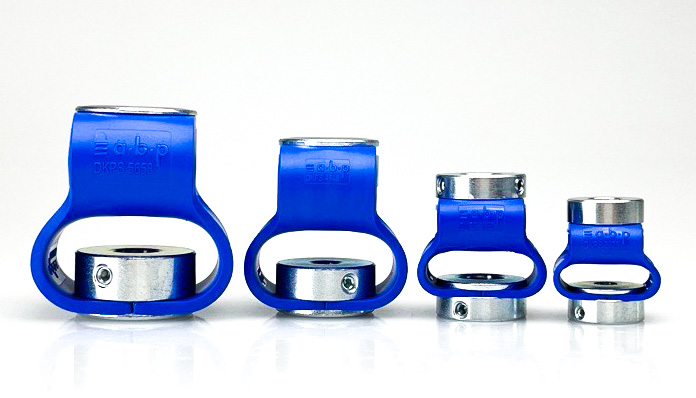
A double loop coupling belongs to the group of flexible shaft couplings. It consists of two hubs and a flexible connecting element.
The connecting element made of polyurethane compensates for different movements between the connected shafts. At the same time, it reliably transmits torque and its material properties provide damping of shocks and vibrations.
Which types of misalignment can a double loop coupling compensate for?
The main strength of the double loop coupling is its ability to compensate for different types of misalignment.
Misalignment | Beschreibung | Benefit |
Radial misalignment | Lateral offset of the shaft axes | Reduction of additional bearing forces |
Axial misalignment | Displacement along the shaft axis | Compensation of thermal movements |
Angular misalignment | Deviation between the shaft axes | Safe operation despite assembly deviations |
The flexible design of the connecting element allows relatively large misalignments to be compensated. At the same time, the dimensions remain compact and the design remains simple.
Temperature and Media Resistance
The polyurethane used can be used over a wide temperature range.
The permitted temperature range is:
-30 °C to +80 °C
It should be noted that the mechanical properties of the polyurethane may change at temperatures outside the specified temperature range.
The material also has good resistance to many media.
These include:
- Petrol
- Oil
- Benzene
- Toluene
- Aromatic and non aromatic hydrocarbons
- Alcohols
- Glycols
- Solvents
- Many chemicals
The polyurethane used has good resistance to various media used in industry. Suitability depends on the medium, concentration, temperature and exposure time.
This means that the double loop coupling can also be used in more demanding industrial environments.
When is a double loop coupling the right choice?
A double loop coupling is particularly suitable when several requirements need to be met at the same time:
- Compensation of shaft misalignment
- Reduction of vibrations
- Protection of sensitive components
- Maintenance free operation
- Compact design
- Electrical isolation
- Thermal isolation
This type of coupling is particularly suitable for applications where complete shaft alignment cannot be permanently guaranteed during operation.
Typical causes include:
- Changing temperature conditions
- Dynamic machine movements
- Installation conditions with limited space
- Manufacturing and installation tolerances
Typical applications of the double loop coupling
Due to its properties, the double loop coupling is used in many industrial areas.
- Mechanical and plant engineering
- Conveyor technology and dynamic applications
- Food and beverage industry
- And many more
Selection criteria
The correct selection of a shaft coupling starts with a detailed consideration of the application.
The following points should be considered:
Selection criterion | Meaning |
Torque | Determines the required coupling size |
Speed | Influences the mechanical load |
Shaft dimensions | Important for bore size and assembly |
Types of misalignment | Determines the required compensation capability |
Temperature | Relevant for material selection |
Environment | Influences the material and design |
Installation space | Determines the suitable design |
Careful design helps to find a reliable and durable solution
Double Loop Couplings for Modern Drive Systems
Modern machines place high demands on the components used. In addition to precision and reliability, easy assembly, maintenance free operation and flexible applications are becoming increasingly important.
The double loop coupling meets these requirements through a combination of:
- Proven design
- Modern materials
- High compensation capability
- Low maintenance requirements
This makes it an interesting solution for many drive technology applications even as requirements increase.
In a nutshell
The double loop coupling combines flexibility, reliability and low maintenance requirements in a compact solution.
Its key benefits:
- Compensates for radial, axial and angular misalignment
- Reduces loads on bearings and shafts
- Dampens shocks and vibrations
- Provides thermal and electrical isolation
- Provides thermal and electrical isolation
- Suitable for many applications in mechanical engineering and measurement technology
By combining a proven design principle with modern materials, the double loop coupling provides an economical solution for many tasks in industrial drive technology.